
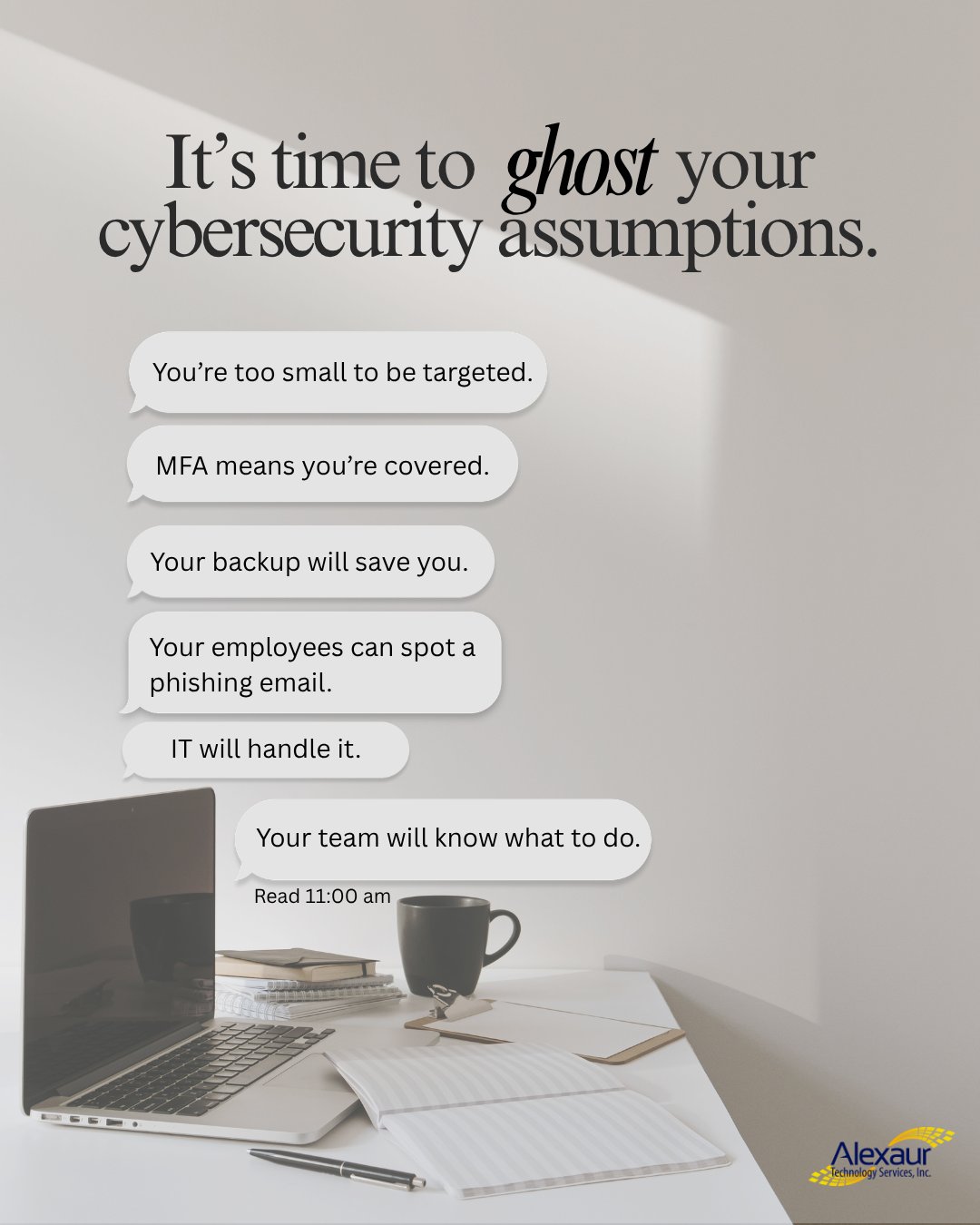
Every October, Cybersecurity Awareness Month gives business owners a reason to pause and ask a simple question: is what we believe about our security actually true?
For many small businesses, the honest answer is "not entirely." Security advice gets passed around between colleagues, vendors, and online forums until it feels like common knowledge, even when it stopped being accurate years ago. Those outdated beliefs become weak spots, and weak spots are exactly what attackers go looking for.
The upside is that most of these gaps are easy to fix once you can see them. Below are six cybersecurity myths we regularly hear from local business owners, and what's really going on behind each one.
Myth #1: "Hackers Don't Bother With a Small Business in Katy"
It's easy to assume cybercriminals are focused on big Houston energy companies and national brands, not a dental practice off Mason Road or a family-owned contractor near the Grand Parkway. Unfortunately, that's not how modern attacks work.
Most attacks are automated. Criminals run tools that scan the internet around the clock for unpatched software, weak passwords, and exposed remote access, and they don't check your headcount before breaking in. A small business also holds things worth stealing: Customer records, payroll data, banking access, and trusted connections to larger clients and suppliers. For attackers, a smaller company is often the easier route into a bigger one.
The reality: Attackers look for vulnerabilities, not company size. If you're online, you're a target.
Myth #2: "Our Team Can Spot a Phishing Email"
Remember when scam emails were easy to recognize, with broken English, strange formatting, and obviously fake senders? Those days are mostly over. AI tools now let criminals write clean, professional messages that reference real vendors, real coworkers, and even real projects your business is working on. Because the writing itself is no longer a reliable warning sign, local employees need to focus on what the email is asking them to do. Slow down and ask whether the person supposedly sending it would normally:
- Ask for something urgent or out of the ordinary
- Request a change to banking or payment details
- Ask for passwords, tax forms, or other sensitive information
- Send an unexpected login link or file-sharing request
When something feels off, verify it through a separate channel, such as a phone call to a number you already have on file, before clicking, paying, or replying.
The reality: A well-written, friendly email can still be a scam. Judge the request, not the grammar.
Myth #3: "We Turned On MFA, So Our Accounts Are Safe"
Multi-factor authentication (MFA) is one of the best security steps a small business can take, and every company should be using it. But it isn't a force field.
One common tactic is MFA fatigue, where an attacker who already has a stolen password triggers approval prompt after prompt on an employee's phone. Eventually, someone taps "Approve" just to make the notifications stop or assumes it's a glitch. Attackers also use fake login pages that capture both the password and the one-time code in real time.
MFA works best when it's paired with stronger options like number-matching or app-based authentication, alerts for suspicious sign-ins, and employees who know to report unexpected prompts instead of approving them.
The reality: MFA is an important layer, but it needs other safeguards around it to be effective.
Myth #4: "We Have Backups, So Ransomware Isn't a Big Deal"
Here's a question worth asking your team this week: if ransomware locked every computer in your office tomorrow morning, how long would it take to get back to work? Hours? Days? Do you actually know?
Many businesses have backups running but have never tried restoring from them. That's where unpleasant surprises happen. Backups can be incomplete, corrupted, stored on the same network the ransomware just encrypted, or simply too slow to restore in a reasonable time frame. Along the Gulf Coast, the same question applies to hurricanes, flooding, and extended power outages, like the ones many local businesses dealt with after Hurricane Beryl in 2024.
Regular restore testing, at least one offsite or cloud copy kept separate from your main network, and a clear sense of your recovery time turn a backup from a hopeful guess into a real plan.
The reality: Backups only matter if you've proven you can restore from them, and quickly.
Myth #5: "Cybersecurity Is Our IT Provider's Job"
Your IT team or managed service provider handles a lot behind the scenes: firewalls, updates, antivirus, monitoring, and more. What they can't do is sit next to every employee and approve every click, download, and payment request. Security decisions happen all day long in every part of your business, from the front desk to accounting to the sales team working from home. A single rushed click on a malicious link can undo a lot of good technical protection.
That's why ongoing security awareness training matters. When employees understand the common tricks, feel comfortable asking questions, and know exactly who to contact when something seems wrong, they become an active part of your defense instead of your biggest risk.
The reality: Technology protects your systems, but trained people protect your business.
Myth #6: "We'll Figure It Out If Something Happens"
Picture this: it's a busy Monday in Houston. Traffic on I-10 is backed up, the phones are ringing, and suddenly half your staff can't open their files. Screens are showing a ransom note. Everyone looks around for direction, and nobody's quite sure what comes next.
- Should people unplug their computers or leave them on?
- Who contacts your IT provider, and how, if email is down?
- When should your cyber insurance carrier be notified?
- Who decides what to tell customers, and what do you say?
- Do you have legal notification obligations under Texas law?
These are hard questions to answer under pressure. A written incident response plan, shared with key staff and reviewed at least once a year, lets your team act quickly and consistently instead of improvising during a crisis. Texas also has specific rules and deadlines for notifying affected individuals after certain data breaches, so it's wise to understand your obligations ahead of time and talk with an attorney about the details.
The reality: The middle of an attack is the worst time to write your response plan.
Protecting Your Katy Business Starts With the Right Information
Cybersecurity Awareness Month isn't about fear. It's about making sure the beliefs guiding your decisions hold up. Myths are comfortable because they let you feel protected without looking too closely. But most security problems don't come from missing a single tool. They come from assuming something is already covered when it isn't.
If a few of these myths sounded familiar, now is a great time to find out where your business really stands. Our team works with small and mid-sized businesses throughout Katy, Fulshear, Richmond, Brookshire, and West Houston to build practical, right-sized cybersecurity that fits how local companies actually operate.
Book a free 15-minute cybersecurity discovery call. We'll help you sort out what's truly protecting your business from what's just giving you a false sense of security.
Call us at 281-646-1200 or visit us to schedule your call today.