
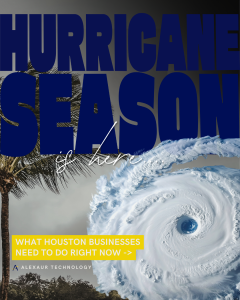
The 2026 Atlantic hurricane season officially runs from June 1 through November 30 - and it's already underway. Across Greater Houston, August and September are historically the most active and potentially most dangerous months. That window is approaching fast, and the time to prepare your operations, protect your assets, and update your business continuity plan is right now.
2026 Hurricane Forecast: A Season to Take Seriously
The NOAA Climate Prediction Center is forecasting a below-normal 2026 Atlantic hurricane season, citing warmer-than-average Atlantic Ocean temperatures and favorable storm development conditions as key contributing factors. Here's what NOAA's official 2026 outlook projects:
- 8-14 named storms (winds of 39 mph or higher)
- 3-6 hurricanes (winds of 74 mph or higher)
- 1-3 major hurricanes (Category 3 or higher, with winds of 111 mph or greater)
These predictions carry a 70% confidence level, underscoring the elevated risk heading into peak season.
Colorado State University's Tropical Weather & Climate Research group echoes this concern, projecting 11 named storms, 5 hurricanes, and 2 major hurricanes for the 2026 season- below historical averages. Even storms that don't make direct landfall can disrupt coastal and inland communities for extended periods through flooding, power outages, and supply chain disruption.
For perspective, the 30-year historical average (1991–2020) is just 14.4 named storms, 7.2 hurricanes, and 3.2 major hurricanes. The 2026 outlook exceeds that baseline, and after several consecutive above-normal seasons, forecasters aren't treating this lightly.
Why Hurricane Preparedness Matters More for Small Businesses
Hurricanes don't hit all businesses equally. Small and medium-sized businesses (SMBs) consistently absorb the hardest long-term blows - even when direct storm damage appears manageable.
The data from past Gulf Coast storms tells a sobering story:
- After Hurricane Harvey in 2017, nearly half of businesses in the Lake Houston area reported storm-related damage.
- FEMA estimates that 40% of small businesses that close due to a natural disaster never reopen.
- Of those that do reopen, 67% fail within two years, largely because continuity systems weren't in place before the storm hit.
And direct damage is only part of the picture. Even a storm that misses Houston can cause serious disruption through:
- Broken supply chains and vendor delays
- Employee displacement and labor shortages
- Extended power outages and internet downtime
- Regional economic slowdowns that suppress demand for weeks
These compounding effects can paralyze operations far longer than the storm itself lasts - and without a plan, the recovery curve is steep.
The Business Costs of Inadequate Preparation
Failing to plan for hurricane season carries real financial consequences:
Lost revenue and productivity. Without access to systems, utilities, or staff, operations stop while fixed costs keep running.
Reputational damage. Customers who can't reach you during or after a storm don't always wait for you to recover. They find alternatives and sometimes stay there.
Lower employee morale. Teams thrown into crisis without clear protocols burn out fast, and some won't return once the dust settles.
Competitive disadvantage. While your business is offline, competitors with better continuity plans are answering your customers' calls. The ground they gain during your downtime can be hard to take back.
Can your business function for 24–48 hours without computers, communications, or utilities? What about five days? If the honest answer is no, or you're not sure, that's the gap to close before August arrives.
How to Prepare Your Houston Business for Hurricane Season
A strong disaster recovery and business continuity plan doesn’t need to be complicated. At a minimum, it should cover these five areas before peak season hits:
🔋 Backup Power and Data Storage Do you have a generator capable of running critical systems? Is fuel stored and accessible? Are your critical business files backed up offsite or in a secure cloud environment?
💻 Remote Work Readiness and Secure Communications Can your team access the systems they need from home or an alternate location? Can your communications infrastructure function without your physical office?
📦 Supply Chain Contingency Strategies Have you identified backup vendors for critical inputs or services? Have you talked to your existing suppliers about their own continuity plans?
🚨 Employee Safety and Emergency Protocols Do your employees know the plan? Is there a designated emergency contact? Have evacuation procedures been reviewed for your specific Houston-area location?
🔄 Recovery Ownership When something breaks, does someone own the resolution by name? The difference between a business that recovers in two days and one that takes two weeks is almost always whether this was defined in advance.
Building these systems before a storm is named costs a fraction of what recovery costs after one makes landfall.
Be Proactive, Not Reactive
The 2026 hurricane season is shaping up to be a dynamic one. But with preparation, your Houston business doesn't have to be caught off guard. Download our free Natural Disaster Survival Guide for Businesses to get started on your plan.
👉 Click here or call (281) 646-1200 to schedule your 15-minute consultation and make sure your business is ready for whatever this season brings.
Serving businesses across Houston, Sugar Land, Katy, Pearland, Pasadena, and the Greater Houston metro.
Sources:
- NOAA 2026 Atlantic Hurricane Season Outlook — noaa.gov
- Colorado State University Tropical Weather & Climate Research — tropical.colostate.edu
- NOAA 30-Year Hurricane Climatology (1991–2020) — nhc.noaa.gov
- FEMA Small Business Disaster Recovery — ready.gov/business

